Hutchinson CareOS One
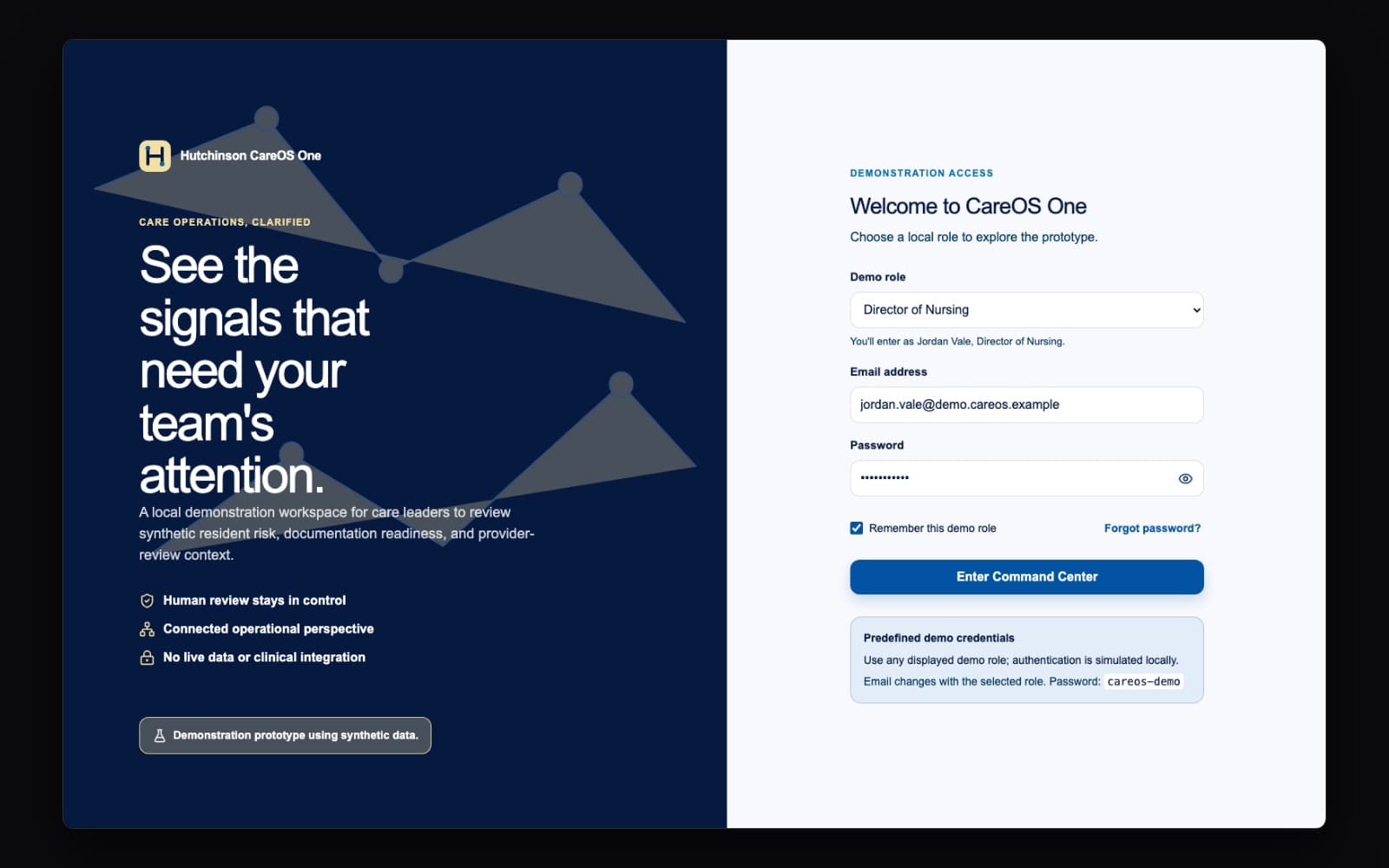
Care Operations, Clarified — a working prototype that gives skilled nursing leaders a connected operational view of resident risk, documentation readiness, and provider-review context, built entirely on synthetic data.
Overview
CareOS One is a demonstration prototype for care facility leaders evaluating operational intelligence. It answers a specific question I kept running into on the floor: what would it look like if the signals a Director of Nursing actually needs — who is at risk, what documentation is incomplete, what is waiting on provider review — were visible in one place instead of assembled by hand from four systems.
The problem
- Operational visibility in a facility is reconstructed manually, usually by the person with the least spare time.
- Risk and documentation gaps surface during review or survey rather than while they can still be corrected.
- Evaluating any new operational tool normally means exposing real resident data before you know whether the tool is worth it.
- Different roles — DON, Administrator, Provider, MDS Coordinator — need different views of the same underlying picture.
Proposed approach
- A single operational view covering resident risk, documentation readiness, and provider-review context.
- Role-based entry: the interface adapts to whether you are a Director of Nursing, Administrator, Provider, or MDS Coordinator.
- Entirely synthetic data and no clinical integration, so the prototype can be evaluated and used for training with no privacy exposure at all.
- Human review stays in control — the system prioritises what needs attention, it does not decide what happens next.
Process
Start from the daily question
Work backwards from what facility leadership actually needs to know at the start of a shift, rather than from what data happens to be available.
Model the roles
Map how the same operational picture differs for a DON, an Administrator, a Provider, and an MDS Coordinator.
Build on synthetic data
Construct a realistic but entirely fabricated resident population so the concept can be shown, tested and taught without touching PHI.
Ship something clickable
Put a working prototype in front of people. Descriptions of operational software persuade nobody who runs a building.
What this has clarified
- Leaders respond to a prototype they can click through in a way they never respond to a slide.
- Building on synthetic data removed the single biggest obstacle to showing the idea at all.
- The hard part is not surfacing information — it is deciding what is worth interrupting someone for.
Next steps
- Gather structured feedback from DONs and administrators working in facilities today.
- Expand the documentation-readiness logic.
- Define what a real integration would require, and what safeguards would have to hold first.
Related projects

SNF AI Documentation System
A structured concept for improving skilled nursing documentation, clinical organization, consistency, and provider oversight with AI-assisted workflows.
AI–Human Work Benchmark Map
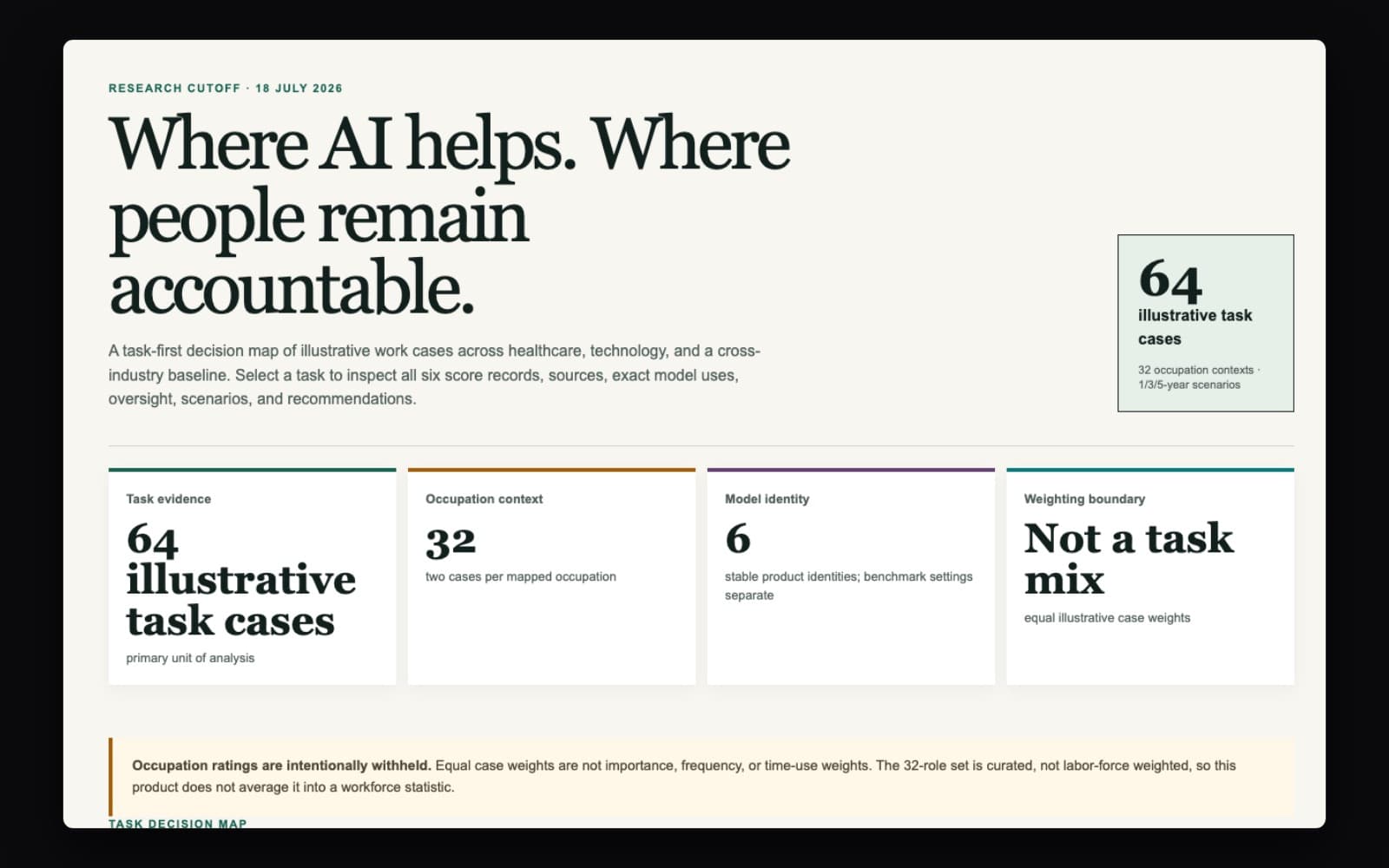
Where AI helps. Where people remain accountable. A task-level decision tool scoring 64 illustrative work tasks across healthcare, technology, and baseline industries against six frontier models.